

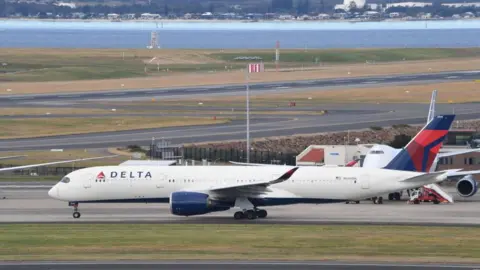
A number of individuals sustained injuries after a Delta jet from Los Angeles to Sydney, Australia encountered rough air Friday morning.
Delta Flight 41 "went through a short bout of rough air" as it touched down at Sydney Airport, a company official informed. Four flight attendants were injured.
The New South Wales Ambulance Service stated they treated five individuals, and transferred three of them to hospital with relatively minor issues that included spinal discomfort and headaches. Those affected spanned from their 30s to 70s.
This marks the latest incident of planes encountering atmospheric disturbance, with researchers saying that global warming is a major factor.
The aircraft was carrying 245 people and a crew of 15 on the wide-body jet, the representative added, clarifying that the plane touched down "without further incident" at Sydney Airport at 06:48 local time on Friday morning.
Emergency responders reported they got a call just only 180 seconds before the plane arrived, and response teams were ready and waiting at the airport.
Why in-flight bumpiness is growing more common - and more severe.
During the past year, twenty-five passengers and crew were hurt when another Delta jet, flying from Salt Lake City to Amsterdam, encountered "significant" rough air just 120 minutes into the transoceanic journey, and diverted for an precautionary landing.
Recently, travelers and staff on a Singapore Airlines jet went through a frightening brief five-second of severe turbulence. An individual died and many were hurt, as individuals not fastened in lifted out of their seats and fell back down.
Bumpy air is not uncommon while flying, and while cases of significant turbulence appear to be increasing, they are remained quite uncommon.
Estimates show that there are approximately five thousand cases of significant in-flight disturbance every year, out of a total of over 35 million flights that are conducted worldwide.
Intense turbulence is categorized as when the sudden jolts of a aircraft going through rough air masses exert in excess of 1.5g-force on your body - a strong enough force to throw you from your seat if you were not fastened by a seatbelt.
As climate change modifies weather patterns, specialists caution that air travel could become bumpier: warming trends and altered air currents in the higher altitudes are likely to boost the regularity and severity of dangerous in-flight bumps.


